Horton Plains National Park
Horton Plains National Park
A windswept wilderness above the clouds
High in the southern plateau of Sri Lanka’s central highlands lies a world unlike any other in the island. Horton Plains is a mystical landscape where cloud forests open suddenly into sweeping grasslands, where ancient peaks pierce shifting mist, and where silence feels almost sacred. This otherworldly plateau, once known as Maha Eliya Tenna, has been shaped by nature, history and myth. Stone tools linked to the Balangoda culture reveal that humans walked these high plains tens of thousands of years ago.
Today, Horton Plains is a UNESCO World Heritage treasure and one of the country’s most iconic natural sanctuaries. For travellers, it offers a rare blend of high altitude adventure, cinematic scenery and some of Sri Lanka’s most elusive wildlife.


Wildlife of Horton Plains
Horton Plains is one of Sri Lanka’s richest biodiversity hotspots, harbouring species found nowhere else on earth.
Landscapes
The park features two main ecosystems:
-
Montane grasslands sweeping across open plains
-
Evergreen cloud forests where moss-laden branches form thick canopies
This plateau also nourishes three of Sri Lanka’s major rivers and sustains nearly 750 species of plants, including orchids, dwarf bamboo and rare ferns.
Mammals
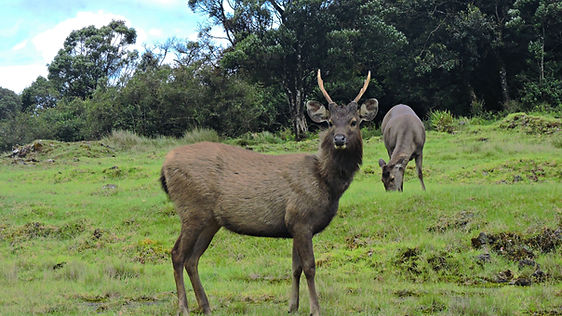
The most iconic resident is the Sambar deer, often seen grazing in the early light. The park is also home to:
-
Toque macaque
-
Purple faced langur
-
Giant squirrel
-
Fishing cat
-
Wild boar
-
Spotted chevrotain
-
Strip necked mongoose
-
Sri Lankan leopard
-
The critically endangered Red slender loris
Birdlife
Horton Plains is a sanctuary for bird enthusiasts with 87 species, including 21 endemics. Highlights include:
-
Sri Lanka super fowl
-
Sri Lanka junglefowl
-
Yellow fronted barbet
-
Sri Lanka bush warbler
-
Sri Lanka whistling thrush
-
Orange billed babbler
Some species occur only here, such as the Sri Lanka magpie, Dull blue flycatcher, Sri Lanka white eye and Sri Lanka wood pigeon. Raptors like the mountain hawk eagle and crested serpent eagle often glide above the plains.
Reptiles, Fish and Amphibians
Unique highland species include:
-
Rhino horn lizard
-
Common rough sided snake
-
Montane amphibians restricted to cloud forests

Getting there?
The national park sits at an altitude of 2100 to 2300 meters, making it one of Sri Lanka’s highest plateaus. It is accessible through:
-
Ginigathena route at 185 kilometres from Colombo
-
A5 Road via Gampola and Nuwara Eliya, stretching 228 kilometres
Once you reach the entry gate near Ohiya, the highland scenery transforms into a dramatic blend of rugged cliffs, rolling pastures and wind-sculpted cloud forests.
In 2006, the region, together with Peak Wilderness and the Knuckles Conservation Forest, was declared a UNESCO World Heritage Site due to its ecological significance and hydrological importance.
How to explore?
Unlike many national parks, the beauty of Horton Plains unfolds only on foot. Vehicles are not permitted beyond the entrance. This invites travellers to experience the land intimately, step by step, as the terrain opens into hidden valleys, streams and panoramic viewpoints.
The classic circular trail takes you past the iconic World’s End escarpment, the upper montane forests and the cascading waters of Baker’s Falls.


Scenic Icons of Horton Plains
World’s End
A sheer vertical drop of 700 metres that reveals a breathtaking valley panorama. On clear mornings, the view stretches endlessly across tea country, lowlands and distant reservoirs.
Baker’s Falls
A beautiful waterfall framed by lush forest, often wrapped in a soft veil of mist with rainbows forming in the spray during sunny moments.
Why Horton Plains Belongs on Your Journey
Horton Plains is an encounter with Sri Lanka at its most dramatic and untouched. Walking through landscapes carved by wind and cloud feels almost dreamlike. This is where time slows, where nature speaks in silence, and where travellers find themselves not just exploring, but reconnecting.